By Valerie Mitchell · Client Success Manager, Clientomic
Published September 25, 2026
Monthly Google Business Profile management keeps a therapy practice's public information, services, local relevance, and profile activity aligned over time. The Counsollogy, LLC case documents one profile's result. It does not predict what another practice will achieve.
Monthly management changes a Google Business Profile from a one-time listing into an actively maintained source of public practice information. A Google Business Profile, or GBP, is the business listing a practice controls across Google Search and Google Maps. Recurring work keeps the practice name, contact details, hours, services, location or service-area information, updates, public Q&A, and performance review aligned with the real business. For a therapy practice, that also means describing specialties and availability carefully without publishing private client information or making clinical promises. The value is consistency, clear ownership, and a record of what was changed. It is not control over Google's placement, and it does not establish future calls, appointments, patients, revenue, or treatment outcomes. The published Counsollogy, LLC result is one example of this operating model, not a benchmark for other practices.
Monthly Google Business Profile management is not a one-time listing cleanup; it is the ongoing operation of a practice's public services, location details, updates, questions, and performance signals. Google lets an authorized business edit information such as its hours, contact details, and services, but those details still need a responsible owner who checks that they remain accurate.[2]
A therapy practice should keep every public profile field consistent with the real business and safe for public viewing. That includes the practice's real-world name, primary category, phone number, website or booking path, hours or appointment guidance, services, photos, descriptions, and an eligible address or service area. Specialty wording should describe services the practice actually offers rather than make treatment claims. A storefront should use its genuine staffed location. A home-based or service-area business should follow Google's current display and eligibility rules instead of exposing a private address or using a virtual office. Public business information is different from client information: names, diagnoses, appointment details, and other private records do not belong in profile copy, posts, photos, or Q&A. Accuracy supports a profile that Google and nearby searchers can understand, but completing a field by itself does not guarantee placement or demand.
Google's representation rules require the profile to reflect how the business is consistently represented in the real world. They also prohibit adding unnecessary information to the business name.[3] Google's service-area guidance separates businesses that serve customers at their address from those that travel to customers, so the correct configuration depends on the practice's actual operating model.[4]
Use a short monthly accuracy pass:
The Google Business Profile optimization checklist covers the broader upkeep fields without turning this therapy-specific decision into another setup guide.
A monthly therapy-practice GBP workflow reviews what the public listing says, what has changed in the business, what questions remain unanswered, and what the Performance data records. The recurring work can cover business details, services and specialties, service-area accuracy, topic coverage, profile updates, public Q&A, applicable product or service listings, and date-range comparisons. The cadence should fit the real practice and should not be presented as a rule set by Google. The published Counsollogy, LLC case describes recurring profile updates, public Q&A, product listings, expanded keyword coverage, services, and service-area work. It connects that maintained operating model to documented changes in profile views and interactions compared with the same period a year earlier. The case does not establish which individual activity caused the change, define a universal monthly quota, or show that another practice will reproduce the result. A responsible workflow records each update, keeps patient information off public surfaces, compares matching reporting periods, and separates profile metrics from calls, appointments, patients, revenue, or clinical outcomes.
The Counsollogy record describes recurring updates, public Q&A, product listings, keyword coverage, service, and service-area work rather than a single cleanup (Clientomic case snapshot, 2026).[1]
| Area | What changes over time | Evidence status |
|---|---|---|
| Business details | Recheck the name, phone, hours, website path, and eligible location or service area | Google guidance and article guidance |
| Services and specialties | Keep public offerings accurate, specific, and privacy-safe | Article interpretation grounded in profile fields |
| Updates | Publish useful, current practice information rather than filler | Case documents recurring profile updates |
| Q&A | Monitor and answer public questions with factual practice information | Case documents recurring public Q&A |
| Product or service listings | Use only where applicable and keep descriptions accurate | Case documents recurring product listings |
| Coverage and measurement | Review relevant searches and matching Performance ranges | Case evidence and Google metric guidance |
This rhythm prevents setup-and-forget drift.
Either model can work when one named owner protects access, maintains accurate information, and follows a reliable review rhythm. In-house management gives the practice direct control, but it also requires someone to notice changes, publish updates, answer public questions, and interpret reporting. A managed service assigns that recurring responsibility to a provider while the business retains ownership of the profile. Managed Local Visibility means recurring management of a business's Google Business Profile and related local-visibility work; it is a service category, not a Google product or a ranking promise. Clientomic is a done-for-you local visibility service that manages a therapy practice's Google Business Profile so the practice gets found on Search and Maps without having to handle it themselves. It does not provide clinical care, website development, paid advertising, broader social management, link outreach, or review solicitation. The decision should turn on time, accountability, control, and fit—not an expected ranking or appointment count.
The useful outcome is not a new dashboard. It is a profile whose public details are checked, whose activity has an owner, and whose reporting has clear limits. That is the managed-service promise Clientomic can responsibly make: the defined work is handled while the practice keeps ownership and clinical decisions remain outside the service.
The Google Business Profile management service explains the defined recurring work Clientomic handles. The practice remains the profile owner, and the service does not change the evidence limits described in this article.
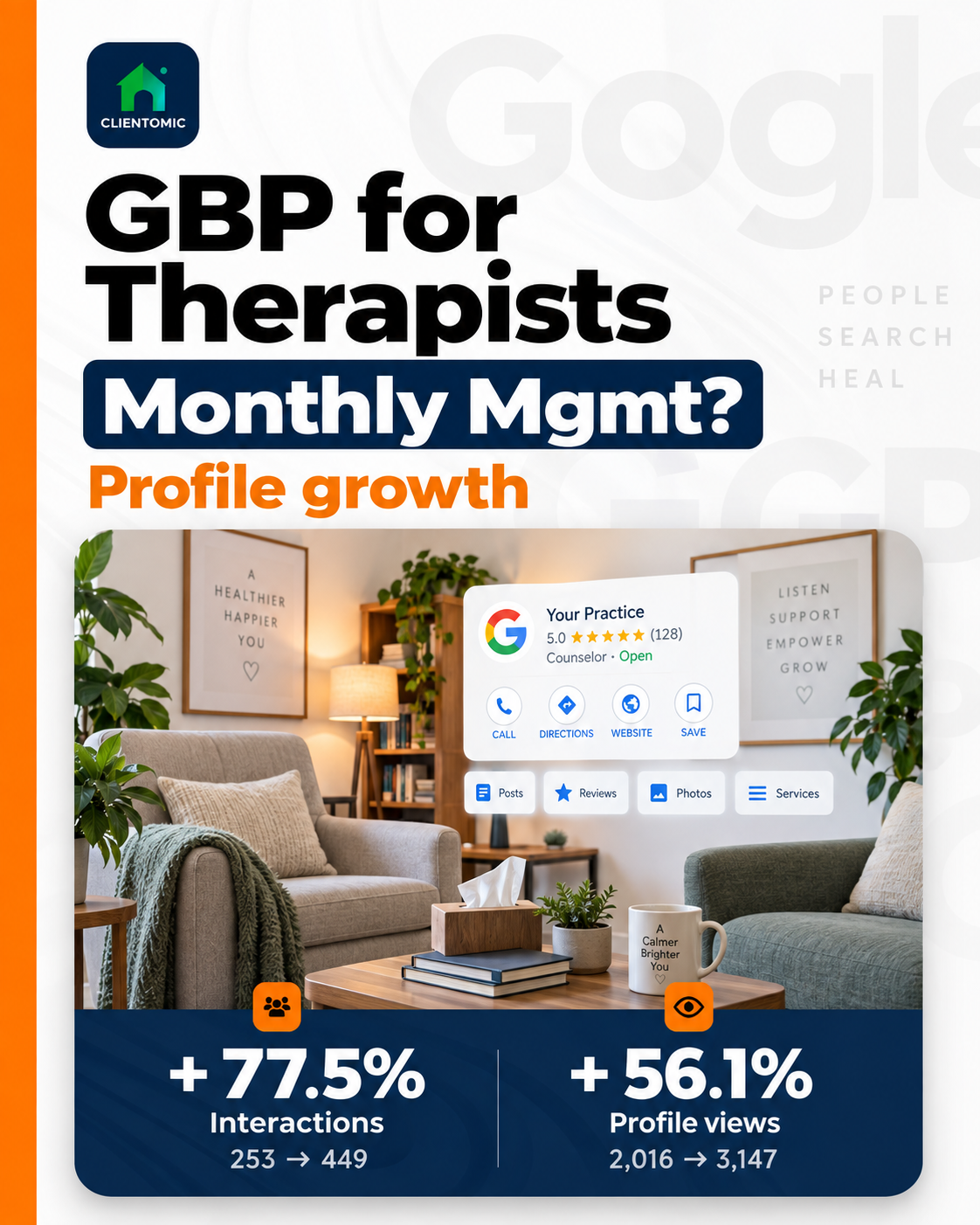
The Counsollogy, LLC case shows published changes for one Boca Raton Google Business Profile compared with the same period a year earlier. The body reports 56% more profile views and 78% more interactions. Its numeric cards show 2,016 → 3,147, labeled +56.1%, for views and 253 → 449, labeled +77.5%, for interactions. Those values document one profile's observed Performance alongside the recurring profile work described on the page. They do not establish a typical therapy-practice result, isolate any single activity as the cause, or forecast calls, appointments, patients, revenue, or clinical outcomes. The source does not provide a controlled comparison. Industry, location, competition, and profile history can all differ, so the case should be read as evidence of past work rather than a guarantee.
Published case evidence: Counsollogy, LLC, Boca Raton
Clientomic's source page describes recurring profile updates, public Q&A, product listings, keyword coverage, services, and service-area work. The body reports 56% more profile views and 78% more interactions compared with the same period a year earlier. The cards print 2,016 → 3,147 (+56.1%) for views and 253 → 449 (+77.5%) for interactions (Clientomic case snapshot, 2026).[1]
The source page presents the same case at two levels of precision: the body says 56% more views and 78% more interactions, while the cards say +56.1% and +77.5% (Clientomic case snapshot, 2026).[1] Each value is kept exactly as published.
A practice should interpret each Google Business Profile metric according to the action it records, then compare matching date ranges before drawing a conclusion. Profile views record how often people viewed the profile. Call data records clicks on the call button, while website data records clicks on the website link. Interactions summarize actions available in Google Business Profile Performance; they are not the same as appointments, patients, or revenue. Tracked rankings are separate observations of where a profile appeared for specified searches and locations, not a Google guarantee. Google Business Profile Performance separates profile views from call-button clicks, so a therapy practice should not treat a views or interactions increase as proof of appointments, patients, or revenue. When a practice comes to us, we check at Clientomic whether these public-platform signals are being kept separate from private practice records, since client information should never appear in reporting notes, posts, or public Q&A.
Google's Performance documentation identifies searches, views, directions, calls, website clicks, messages, and other interactions as separate measures available for a verified profile.[5]
| Metric | What it records | What it cannot establish by itself |
|---|---|---|
| Profile views | Views of the Business Profile | Calls, appointments, patients, or revenue |
| Interactions | Actions reported within GBP Performance | Which action led to an appointment |
| Call clicks | Clicks on the profile's call button | Answered calls or booked appointments |
| Website clicks | Clicks on the website link | Sessions, inquiries, or treatment starts |
| Tracked ranking coverage | Observed placement for defined searches and locations | Future placement or patient demand |
The right review asks whether the profile became more accurate and discoverable, then checks which actions changed. The guide to what improves GBP performance provides a deeper measurement framework. Neither article-level guidance nor a single case replaces the practice's own matching-range analysis.
Confirm that the business name, phone, hours, website path, services, location or service area, updates, and Q&A still match the real practice. Then compare the available Performance range with the prior matching period. The check should record what changed without claiming that the work caused a ranking, call, or appointment outcome.
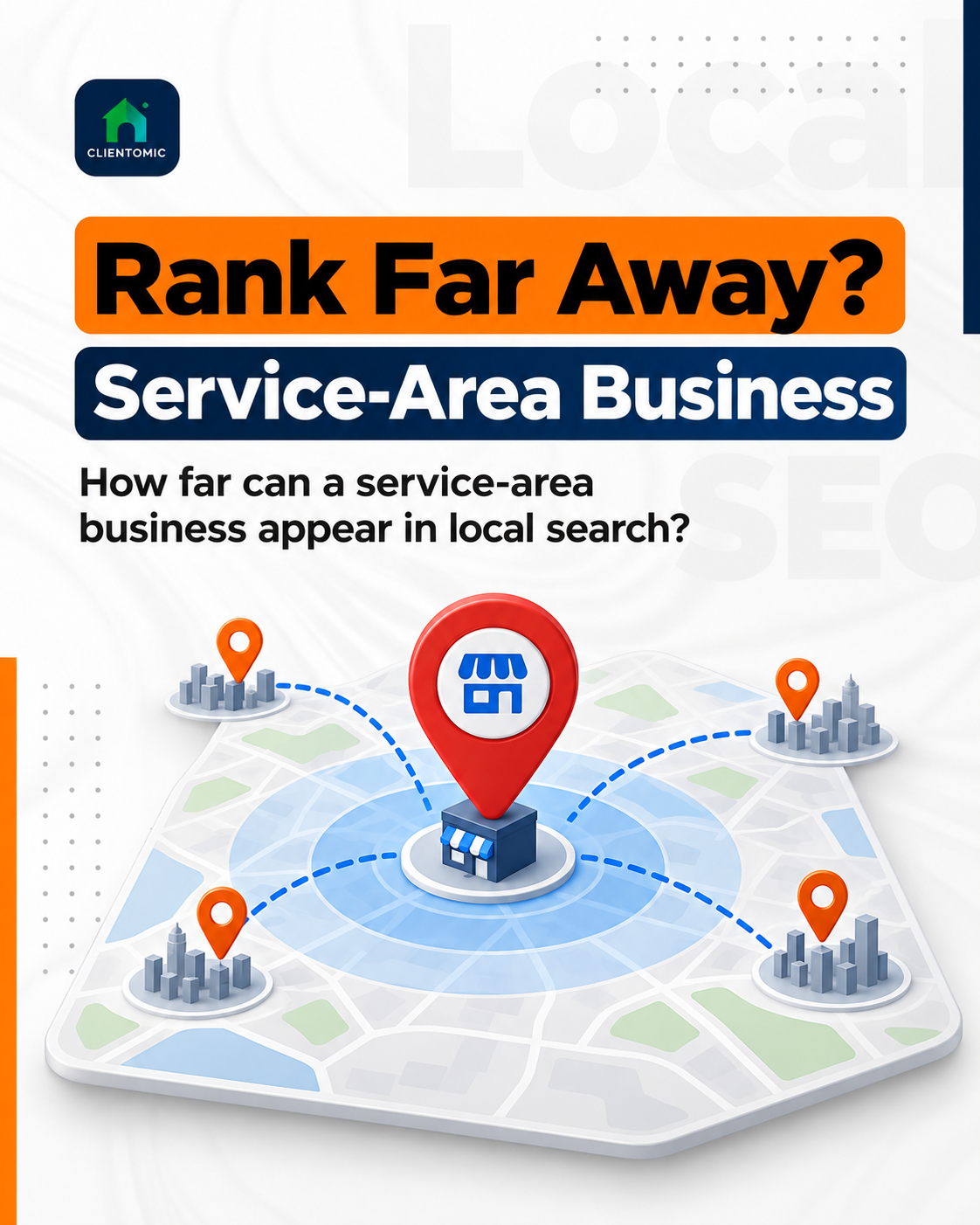
Follow Google's current eligibility and service-area rules for the practice's actual operating model.[4] Do not display a private address merely to complete a field, and do not use a virtual office to create a location signal.[3] If the practice serves people at a staffed location, its configuration may differ from a business that travels to customers.
Check eligibility against the real business model before creating or changing a profile. Google's eligibility guidance requires direct, in-person contact with customers during stated hours, subject to its listed exceptions and current rules.[6] Do not assume that a telehealth-only practice qualifies or that adding a service area resolves eligibility.
Each surface has a different information role. The profile should provide concise, factual public service information, while the website can hold fuller explanations. Keep the descriptions consistent and privacy-safe. Listing a service on either surface does not guarantee placement, and Clientomic's GBP scope does not include building or redesigning a website.
Interactions and call clicks are separate measures. Check the Performance definitions, use matching date ranges, inspect call-button data and website actions, and compare those signals with the practice's own records.[5] An interaction increase can include actions other than calls, so it should not be translated into appointments or patient volume.
A case study reports past observations for one named profile under its own conditions. A guarantee promises a future result. The Counsollogy case reports 56% more profile views compared with the same period a year earlier (Clientomic case snapshot, 2026).[1] It does not establish what another therapy practice will rank for or how many appointments it will receive.
Consistent profile work should be something a practice can assign and verify, not another discipline the owner has to master between appointments. Clientomic manages defined Google Business Profile and local-visibility work while keeping the evidence boundary clear.
Sources:
1. Clientomic, Counsollogy, LLC therapy-practice Google Business Profile case study, source snapshot fetched September 14, 2026. Read the published case
2. Google Business Profile Help, editing business information on Google, 2026. Review the editing guidance
3. Google Business Profile Help, guidelines for representing a business on Google, 2026. Review the representation guidelines
4. Google Business Profile Help, service-area and hybrid-business guidance, 2026. Review service-area guidance
5. Google Business Profile Help, Business Profile Performance and insights, 2026. Review Performance metrics
6. Google Business Profile Help, business eligibility and ownership guidance, 2026. Review eligibility guidance