
By Valerie Mitchell · Client Success Manager, Clientomic
Published August 6, 2026
A better Google Business Profile starts with the facts customers use to choose: your real business name, category, services, hours, service area, phone, and photos. Run a short Google Business Profile audit, fix the highest-risk gaps first, then keep the profile current. No profile edit can guarantee a higher ranking or a specific number of calls.
A Google Business Profile audit is a structured, prioritized review of the business information people see across Google Search and Google Maps. It checks ownership, eligibility, real-world identity, contact details, categories, services, hours, service area, photos, reviews, questions, updates, and performance data. The goal is to identify the safest next actions in the right order. It is not a promise of a particular rank, call count, or customer volume. A one-time audit diagnoses gaps; maintenance keeps corrected information accurate as hours, services, staff, and Google-suggested edits change. Google Business Profile is the current name for the business-managed presence that appears on Search and Maps. Google My Business, often shortened to GMB, is its former name. For a busy owner, the practical distinction matters: an audit finds the work, while a recurring operating rhythm keeps that work from becoming stale again.
A Google Business Profile audit is not a ranking promise; it is a prioritized check of the facts customers and Google use to understand one local business.
Search behavior has also widened. In an Eight Oh Two survey of 500 active AI-tool users, 37% said they begin searches with AI tools rather than traditional search engines (Search Engine Land, 2026).[2] Clear business facts now need to remain consistent wherever a customer starts and wherever they verify the answer.
An accurate, current profile lets nearby customers confirm service fit, hours, location, and the next step without guessing. A stale or misleading profile adds friction to each of those decisions. The first business is easier to choose; the second can lose trust before the phone rings, even when the underlying service is good.
| Audit area | What to inspect | Safe next action |
|---|---|---|
| Access | Owner, managers, verification | Confirm owner-controlled access |
| Identity | Name, phone, hours, address or service area | Match the real business |
| Relevance | Category, services, attributes | Choose specific, truthful options |
| Trust | Photos, genuine reviews, replies | Show current work and answer feedback |
| Activity | Questions, Posts, suggested edits | Correct errors and publish useful updates |
| Measurement | Searches, views, calls, directions, clicks | Save a baseline for comparison |
Fix access, eligibility, and customer-critical facts first. Confirm that an owner-controlled account can manage the profile and that the business is eligible. Then correct the real-world name, phone, website, regular hours, special hours, and either the public address or truthful service area. Next, choose the primary category that most specifically describes the core business, then add only services and attributes the business actually provides. Finish the first pass with useful original photos and thoughtful replies to genuine reviews. Profile accuracy means the listing matches the business a customer would encounter offline. These foundations help Google and customers understand the business, but they do not override distance, competition, relevance, or Google's evaluation. If access or verification is missing, follow the official process before making a string of major edits. A clean sequence reduces both customer confusion and avoidable policy risk.
How can I make my Google Business Profile better? Fix the facts first—business name, category, services, hours, service area, phone, and photos—then maintain the profile and measure the customer actions that follow.
Use this 15-minute pass first:
| Check | Why it matters | Owner action | Customer action to monitor |
|---|---|---|---|
| 1. Access and status | Control comes first | Confirm ownership and verification | Profile views |
| 2. Duplicates or disputes | Conflicts create confusion | Use official support | Searches and views |
| 3. Name and contact facts | Customers need working details | Match name, phone, website, and hours | Calls and website clicks |
| 4. Address or service area | The operating model must be truthful | Show a staffed location or hide the address | Directions or calls |
| 5. Primary category | It defines the core job | Pick the most specific accurate option | Search terms |
| 6. Services and attributes | They clarify fit | Add only facts that apply | Clicks and calls |
| 7. Photos and replies | They show current activity | Add original media and useful replies | Interactions |
Google says complete and accurate information is more likely to appear for relevant local searches, while local results still depend mainly on relevance, distance, and popularity (Google Business Profile Help, 2026).[5] If the access step fails, use the guide to create or claim a Google Business Profile before continuing.
Make the profile easy to choose by removing doubt. Use an accurate category, specific services, current hours, a realistic service area, useful attributes, and original photos of the real operation. Make the next action obvious: the phone number should work, the website should open the right page, and appointment or direction options should match how the business operates. These changes improve customer clarity; they do not create a ranking guarantee. A discovery search is a search for a category, service, or need rather than a known business name. Local visibility is how easily a nearby customer can find, understand, and act on a business across relevant local search surfaces. A strong profile answers three questions quickly: Is this the right service? Is the business available where and when I need it? Can I trust the next step?
BrightLocal's 2025 Consumer Search Behavior research found that 85% of consumers consider business contact information and opening hours important when researching local businesses, so accuracy belongs at the top of a Google Business Profile audit.[1]
| Good signal | Bad shortcut |
|---|---|
| A name that matches real-world branding | Service keywords added to the name |
| A category that describes the core business | Unrelated categories chosen for reach |
| Current regular and special hours | Stale holiday or seasonal hours |
| A truthful service area | Places the team cannot serve reliably |
| Original business photos | Stock imagery presented as proof |
| Genuine reviews and useful replies | Fake, scripted, or incentivized feedback |
Reviews deserve ongoing attention, not a one-time campaign. BrightLocal found that 74% of consumers focus on reviews written within the prior three months (BrightLocal, 2026).[3] Across the service-area profiles we study, we see review freshness as an ongoing trust signal rather than a one-time trophy.
Ask genuine customers for honest feedback through Google's review link or QR code. Clientomic does not generate, buy, script, or incentivize reviews. Google permits requests but prohibits incentives in exchange for reviews (Google Business Profile Help, 2026).[7]
Improve the profile safely by making every edit match the real business and Google's representation policies. Correct inaccurate facts, use the fewest categories needed to describe the core operation, keep one profile per eligible location, and ask only real customers for honest reviews. Treat changes to names, categories, addresses, ownership, and service areas with care because they affect verification. After a material edit, monitor for rejection or re-verification rather than submitting repeated changes. Do not add service keywords to the name, create false locations, duplicate a listing, inflate a service area, or use fake and incentivized reviews. A shortcut that makes the profile less truthful is not optimization. Google may request fresh evidence, and no edit can guarantee visibility. If signage, documents, staff, and customer experience cannot support a claim, it does not belong on the profile.
Google's representation guidelines require accurate real-world names, precise addresses or service areas, a small set of specific categories, and one profile per business location (Google Business Profile Help, 2026).[4]
These boundaries are part of what a GBP audit cannot control: the audit can correct the entity and customer experience, but it cannot purchase a better local position.
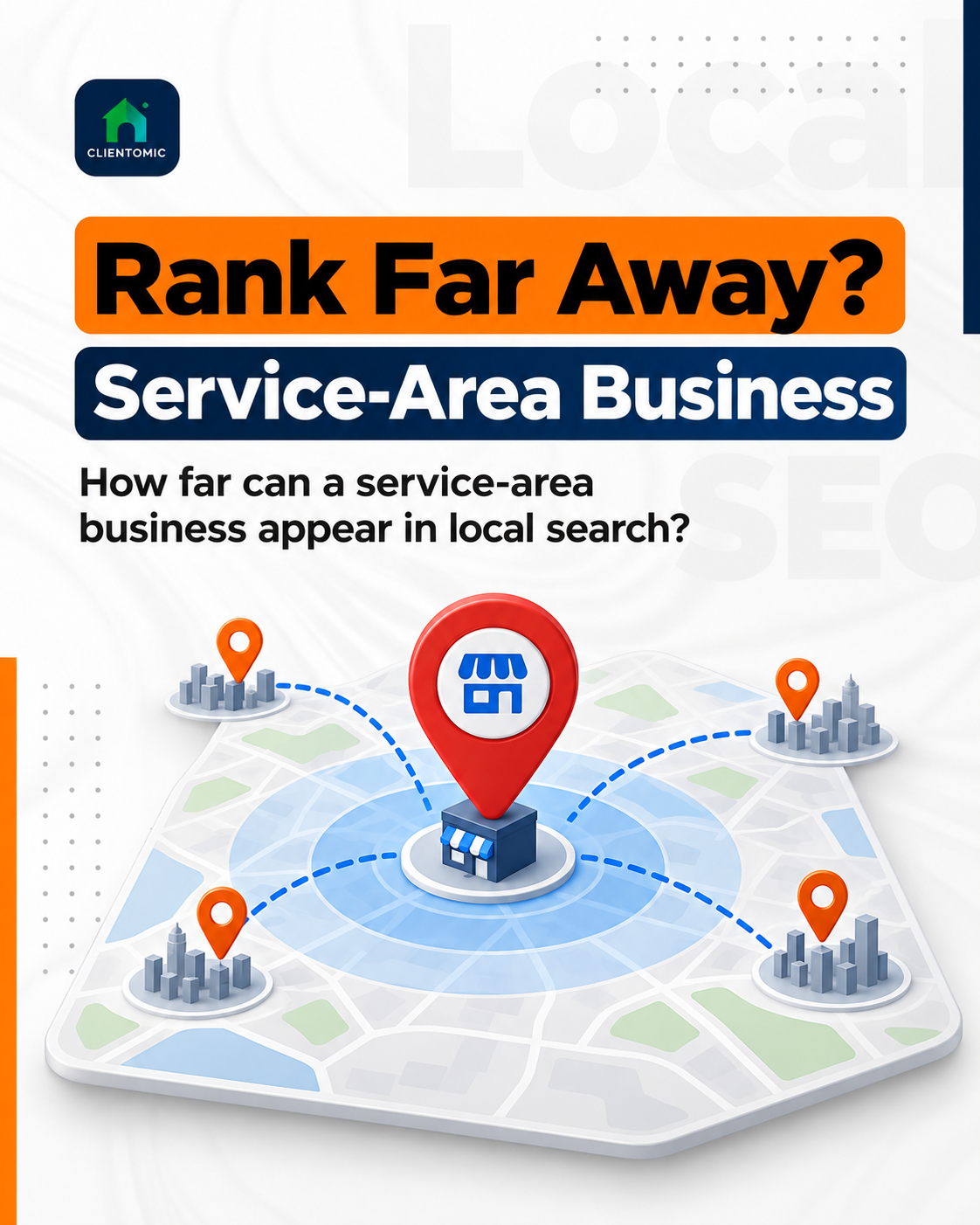
A service-area business should represent the way it actually works. A service-area business travels to customers and may not receive them at a public storefront; a hybrid business both receives customers and travels to them. If customers do not visit the operating address, hide it and list realistic cities, postal codes, or areas the team can serve. If customers do visit, the location should be staffed during stated hours and supported by permanent signage. Service-area settings describe coverage, not guaranteed reach. Google's current representation guidance says the overall area generally should not extend beyond about two hours of driving time from the business base, although some operations may justify more (Google Business Profile Help, 2026).[4] The profile still competes through relevance, distance, and prominence. A broad declared area cannot make a distant business locally close to every searcher, and a fabricated address creates policy risk instead of durable visibility.
A larger service area describes where a business is willing to work; it does not create a larger local ranking radius or override proximity.
When an owner says, "We serve the whole metro," we treat that as a coverage statement, not a ranking promise. The declared area does not erase the proximity limits of local search.
A plumber can list nearby communities the team actually serves without becoming equally visible across the metro. The setting explains availability; a separate visibility diagnostic examines where the profile appears.
The problem is not a shortage of tips. It is a checklist that gives a wrong phone number, a false service area, and another photo the same weight. That format buries the corrections most likely to mislead customers. A one-time cleanup then declares the job finished, so the next holiday-hours change, Google-suggested edit, customer question, or service update has no owner.
Maintain a better profile by assigning recurring ownership to the work. Check customer feedback and questions weekly, keep Google Posts and service updates accurate, and respond to genuine reviews. Each month, review suggested edits, services, photos, search terms, calls, directions, and website clicks. Update special hours and major changes when they happen. This cadence is an operating recommendation, not a Google ranking rule. Recurring management of local profile information and visibility work means the owner does not run the process alone — this is the done-for-you local visibility service that Clientomic provides for small businesses, keeping Google Business Profiles accurate and easy to find without the owner handling it personally. A one-time cleanup can repair today's gaps; it cannot monitor tomorrow's hours, ownership changes, services, customer questions, or incorrect edits. The better operating model is a prioritized, repeatable rhythm the owner can understand, follow, or hand off, so the profile stays current without becoming another recurring marketing task.
The operating rhythm rests on three layers of proof. Google Help defines the representation, accuracy, service-area, and performance rules.[4][5][6] BrightLocal's 2025-2026 research and Search Engine Land's 2026 report provide dated customer and search context.[1][2][3] The bounded practitioner observations connect those rules to review freshness, proximity limits, and the distinct roles of the profile and website. Together, these sources support the operating rhythm; none promises an outcome.
Google's performance report includes views, searches, calls, direction requests, and website clicks, which lets an owner compare customer actions over consistent date ranges (Google Business Profile Help, 2026).[6]
| When | Check | Why it matters |
|---|---|---|
| One time | Ownership, eligibility, duplicates, core facts | Establish a reliable baseline |
| Weekly | Reviews, questions, planned updates | Keep customer-facing information responsive |
| Monthly | Suggested edits, services, photos, actions | Find drift and compare measures |
| Change-triggered | Hours, closures, moves, new services | Prevent customer friction |
Reviewing public cases and our audit work, we see at Clientomic that Google Business Profile discovery and website-owned information function as separate jobs. The profile helps a nearby customer discover and act; the website can hold deeper service detail.
Clientomic tracks and manages 47+ visibility signals across Search, Maps, and AI platforms. Its ongoing GBP management scope uses one fixed monthly service for a single location, with no contracts, transparent reporting, and the option to cancel anytime. It excludes website development, paid ads, link building, social management beyond Google Posts, review generation, and multi-location coverage.
Compare the same date range before and after the fixes. Track calls, directions, clicks, searches, and views as profile actions, not confirmed revenue. Note seasonality beside the comparison.
Check edited fields within a few days. Review activity weekly and complete a fuller check monthly. Update closures, hours, phone numbers, and services immediately.
Stop repeated edits. Check the policy, gather real-world evidence, and follow the official verification or support flow. Keep the facts consistent during review.
Check Google's review policy, save available details, and use official support when appropriate. Never replace missing feedback with bought, scripted, or incentivized reviews.
Yes. Audit the same core facts. Hide the address if customers are not served there and use truthful service areas. Those areas describe coverage; they do not guarantee visibility throughout it.
Run it yourself if you can correct the facts and maintain a weekly and monthly rhythm. Managed upkeep fits when recurring edits, replies, media, questions, and reporting keep slipping.
No. A profile supports discovery and quick actions. A website holds deeper service detail and proof. The audit keeps their business facts consistent but does not replace either asset.
A Google Business Profile audit sets the foundation, but the real gains come from keeping that foundation accurate week after week, month after month.
Sources:
1. BrightLocal, Consumer Search Behavior research, 2025. Read the research
2. Search Engine Land, report on Eight Oh Two's 2026 AI and Search Behavior Study, 2026. Read the report
3. BrightLocal, Local Consumer Review Survey, 2026. Read the survey
4. Google Business Profile Help, Guidelines for representing your business on Google, accessed 2026. Read the guidelines
5. Google Business Profile Help, Tips to improve your local ranking on Google, accessed 2026. Read the guidance
6. Google Business Profile Help, Understand your Business Profile performance and insights, accessed 2026. Read the guidance
7. Google Business Profile Help, Tips to get more reviews, accessed 2026. Read the guidance
Observations sourced from review of public-community discussions on LocalSearchForum, Reddit r/smallbusiness/r/SEO/r/localseo, and Google Business Profile Help Community in 2025-2026, alongside Clientomic's profile-audit and onboarding work. Patterns reflect qualitative observations across multiple independent threads, not specific customer disclosures.