By Ivan Kalin · Local SEO Expert & Founder at Clientomic
Published September 16, 2026
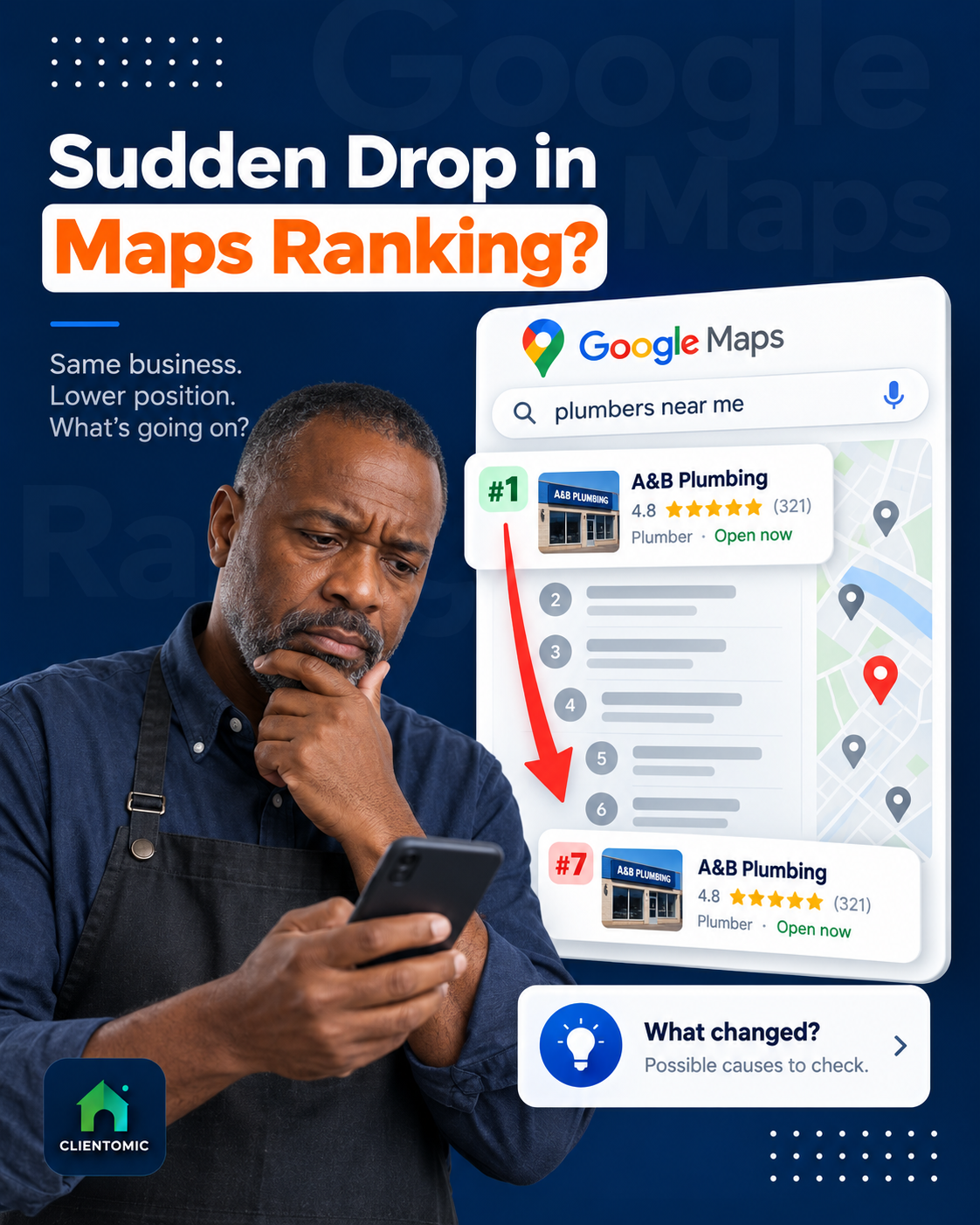
A Google Maps ranking drop does not automatically mean your profile was penalized. First repeat the same query from the same location and device, then check whether the change affects Maps, the Local Pack, Local Finder, or organic results. Next inspect the profile for edits, policy issues, duplicates, and changes in relevance, distance, or prominence.
A Google Business Profile (GBP) is the business-managed presence shown across Google Search and Maps. A ranking drop is a repeatable decline under controlled search conditions, not one lower result on an owner's phone.
Did your Google Maps ranking actually drop, or did the search location, device, query, or result type change? One personal search cannot establish a decline. Repeat the same wording from a consistent location and device, record the date, and identify the surface before editing your profile. Then compare several places where customers realistically search. Google Maps, the Local Pack, Local Finder, and organic results are separate measurement objects, as are calls, direction requests, and website clicks. Search Console can help explain an organic traffic change, but it does not report your position inside Maps. Google Search Central recommends comparing up to 16 months of Search Console data to separate a current organic decline from seasonality (Google Search Central, 2026).[2] A controlled check can confirm that visibility changed under stated conditions. It cannot identify the cause by itself.
Run this five-minute baseline before touching the profile: write down the query, search location, device, result surface, and date. Save a screenshot or a short written record. A structured Google Business Profile audit can follow once that baseline exists.
| Signal | What it can show | What it cannot prove |
|---|---|---|
| Maps or Local Finder position | Visibility for a query from a stated place | A universal position across town |
| Organic Search Console data | Query, page, device, and time trends | A Maps position |
| Calls, directions, website clicks | Actions recorded from the profile | Why a position changed |
Local results respond to both the searcher's location and the result surface being inspected. Google Maps is the Maps interface and its location-sensitive business results. The Map Pack, also called the Local Pack, is the local business block embedded in Google Search. Local Finder is the expanded local result set opened from that block. An organic local result is a standard webpage result with local intent. These surfaces can show different businesses in a different order, and industry reporting documents that Maps and local Search results are not interchangeable (Search Engine Land, 2025).[3] A search from the shop, a customer's neighborhood, and the far edge of a service area can therefore produce different evidence. If the location, device, wording, or surface changed, the apparent decline may be a measurement difference rather than a damaged profile.
When a plumber says it serves the whole metro, we treat that as a coverage statement, not a ranking promise; the service area does not erase the proximity limits of local search.
| Surface | What it is | Controlled check |
|---|---|---|
| Google Maps | The Maps interface | Repeat the same query from named customer locations |
| Local Pack | The local block in Search | Record the device, query, place, and date |
| Local Finder | The expanded local set | Compare it with the same Local Pack search |
| Organic result | A normal webpage listing | Review Search Console separately |
A changed profile field can alter what Google understands about the business, but the change alone does not prove unauthorized access. Review Google notifications, linked-account activity, and the current values for the business name, primary category, hours, address or service area, map pin, services, and photos. Google explains that profile information can come from owner edits, other sources, and Google-collected updates, and some edits remain under review before they appear (Google Business Profile Help, 2026).[4] Document the exact field, its earlier value, its current value, the date, and the source of the evidence. Correct one inaccurate field so the profile represents the real business. Do not rewrite the name to include search terms, move the pin away from the operating location, or change several fields together. One documented correction preserves a clean before-and-after comparison.
Use a small change log instead of relying on memory:
| Field | Observed change | Evidence | Next action |
|---|---|---|---|
| Primary category | Old value versus current value | Notification and screenshot | Restore the accurate category if evidence supports it |
| Hours | Regular or special hours changed | Live profile and business schedule | Submit the real operating hours |
| Address, service area, or pin | Location data differs | Profile record and real-world documents | Correct only the inaccurate value |
Separate ordinary position movement from an eligibility or access problem. Check whether the live profile is visible, verified, and editable. Read every notice in the profile account, then search the business name and address for a duplicate. Google's representation guidelines require accurate real-world information and generally one profile per business (Google Business Profile Help, 2026).[5] If Google shows a suspension, restriction, or verification state, use the official support or appeal path and prepare evidence that matches the real business (Google Business Profile Help, 2026).[6] Do not create a replacement listing while the original issue is unresolved; another profile can add conflicting information and make the diagnosis harder. A policy state calls for a policy and support review. It does not support a promised reinstatement date or a return to a particular position.
Red flags: the profile is absent or inaccessible; Google shows a suspension or policy notice; a second listing uses the same business details; the address or service area is inaccurate; or the profile cannot be edited by an authorized owner.
Google describes local ranking through three main ideas: relevance, distance, and prominence (Google Business Profile Help, 2026).[1] Relevance asks whether the primary category, services, and factual profile information match the search. Distance asks how far the searcher is from the business or service location. Prominence concerns how well-known or established the business appears through available information, including links and reviews. Google does not publish a fixed weighting for these factors. A business can keep its category, services, hours, and other facts accurate, but it cannot make its real location equally close to every searcher. Whitespark's 2026 Local Search Ranking Factors report offers directional expert-survey context, not Google's formula (Whitespark, 2026).[7] Use that survey to form questions, then verify those questions against the actual profile and controlled searches.
In our profile-audit work at Clientomic, when a plumber reports a visibility drop, we first check whether Google's primary category still matches the trade the business actually performs.
| Pillar | Diagnostic question | Safe action |
|---|---|---|
| Relevance | Does the category and service information still match the query? | Correct factual mismatches |
| Distance | Did the search move to another neighborhood? | Compare the same query across customer-relevant locations |
| Prominence | Did the comparative result set change? | Review documented profile and market signals without assuming a fixed weight |
Category fit is not permission to add terms to the business name. Use the name the business uses in the real world and the fewest accurate categories needed to describe it.
Local search is comparative and dynamic. Another business may improve its profile, the result set may change, or a confirmed Google update may provide timing context. Google's Search Status Dashboard records the August 2026 spam update starting August 18 and lasting 2 days and 16 hours (Google Search Status Dashboard, 2026).[8] That event establishes a date window for broad Search analysis; it does not establish a Maps-specific penalty. Search Engine Land also reported SE Ranking data showing that 16.71% of top-10 organic URLs fell beyond position 100 during that update, compared with 9.2% in a July period (Search Engine Land, 2026).[9] The study covered 100,000 US keywords across 20 industries and measured organic results. Compare affected queries, nearby businesses, Search Console trends, and the update window, but keep organic evidence separate from Maps evidence.
Google's Search Status Dashboard records the August 2026 spam update from August 18 for 2 days and 16 hours; that timing is context for a broad decline, not proof that a local profile was penalized.
Search Engine Land's report of SE Ranking data found that 16.71% of top-10 organic URLs fell beyond position 100 during the August 2026 spam update, versus 9.2% in a comparable July period.
To test a competitor hypothesis, compare the same query and locations against your saved baseline. Note which businesses entered or left the result set and whether the change is narrow or widespread. For ongoing work after the immediate diagnosis, see what actually improves Google Business Profile performance.
Use a fixed recovery order: verify the symptom, isolate the affected surface, inspect profile and policy state, compare nearby results and dated update context, make one evidence-backed correction, and monitor the same evidence. Do not create a duplicate, add search terms to the business name, move the map pin away from the real location, or change every field at once. Do not treat one search as a universal position report. Monitoring should repeat the same queries, customer-relevant locations, devices, and surfaces while keeping calls, directions, and website clicks in a separate outcome record. This process will not promise a recovery date or position. It will tell you whether a change is real, which explanation the evidence supports, and whether the correction affected the symptom you originally recorded.
A local visibility audit is a structured check of where a business appears across selected local searches and whether its profile facts are accurate. For businesses that would rather not manage this themselves, Clientomic operates as a done-for-you local visibility service, managing Google Business Profiles on behalf of owners so they get found on Search and Maps without doing the recurring work themselves. Google still controls its own ranking decisions regardless of who manages the profile.
Capture the full result, the exact query, the date, the device, and the search location. Include enough screen context to identify whether you are viewing Maps, the Local Pack, or Local Finder. Also record the current profile fields that may change. The screenshot preserves a baseline; it does not identify the cause.
Choose a few places where real customers are likely to search: near the business, within the usual service area, and toward its practical edge. Use the same query and device conditions at each point. The goal is to compare location sensitivity, not to claim one position for an entire city.
Treat visibility and calls as separate evidence. Confirm that the phone number and call path work, compare calls with directions and website clicks, and check whether the same queries still show the profile. A visible profile can receive fewer actions even when its recorded position appears stable.
Keep the submitted value accurate and save the confirmation. Avoid resubmitting different versions while Google reviews the edit. Check the profile and notifications for a status change, then use the official support path if the review does not resolve. A pending edit does not justify creating another profile.
No. First repeat the query under controlled conditions and confirm the current category is factually wrong. If it accurately describes the main business, one poor result is not enough evidence to replace it. If the category changed or no longer matches the real service, document the mismatch before correcting it.
Track both, but do not combine them into one measure. Controlled rankings show where the business appeared for stated searches. Calls, directions, and website clicks show recorded actions. Comparing both helps separate a visibility change from a conversion or contact-path problem.
The core checks are the same: reproduce the query, identify the surface, inspect profile state, review edits, and compare locations. A service-area business must also confirm that its address and service-area settings follow Google's representation rules. Declared coverage does not remove the effect of searcher distance.
If a Google Maps ranking drop is costing you time you do not have, Clientomic can take the recurring profile work off your plate.
Sources:
1. Google Business Profile Help, guidance on relevance, distance, prominence, and complete profile information, accessed 2026. Read the local ranking guidance
2. Google Search Central, guidance for diagnosing Search traffic drops with comparisons and up to 16 months of context, accessed 2026. Read the diagnostic guide
3. Search Engine Land, explanation of Google Maps, Local Pack, and Local Finder distinctions, updated 2025. Read the guide
4. Google Business Profile Help, guidance on editing profiles and Google-collected information, accessed 2026. Read the editing guidance
5. Google Business Profile Help, guidelines for accurate business representation and duplicate prevention, accessed 2026. Read the representation guidelines
6. Google Business Profile Help, official guidance for suspended or disabled profiles, accessed 2026. Read the appeal guidance
7. Whitespark, 2026 Local Search Ranking Factors report, published 2025 and accessed 2026. Read the expert survey
8. Google Search Status Dashboard, August 2026 spam update history, accessed 2026. View the status history
9. Search Engine Land, report on SE Ranking's analysis of the August 2026 spam update, 2026. Read the analysis
Observations sourced from review of public-community discussions on LocalSearchForum, Reddit r/smallbusiness/r/SEO/r/localseo, and Google Business Profile Help Community in 2025-2026, alongside Clientomic's profile-audit and onboarding work. Patterns reflect qualitative observations across multiple independent threads, not specific customer disclosures.