By Valerie Mitchell · Client Success Manager, Clientomic
Published July 22, 2026
A Google Business Profile helps nearby customers find and contact a local business on Google Search and Maps. A business website gives that business an owned place to explain services and guide visitors to the next step. Search Engine Land reported in 2026 that 37% of consumers started searches with AI tools instead of traditional search engines, which makes clear business facts useful across more discovery surfaces.[3]
What is the difference between having a Google business profile and building a business website? One earns discovery inside Google. The other gives the business room to answer deeper questions on a domain it controls. Most local businesses benefit from both, but the right first step depends on which gap is costing customers now.
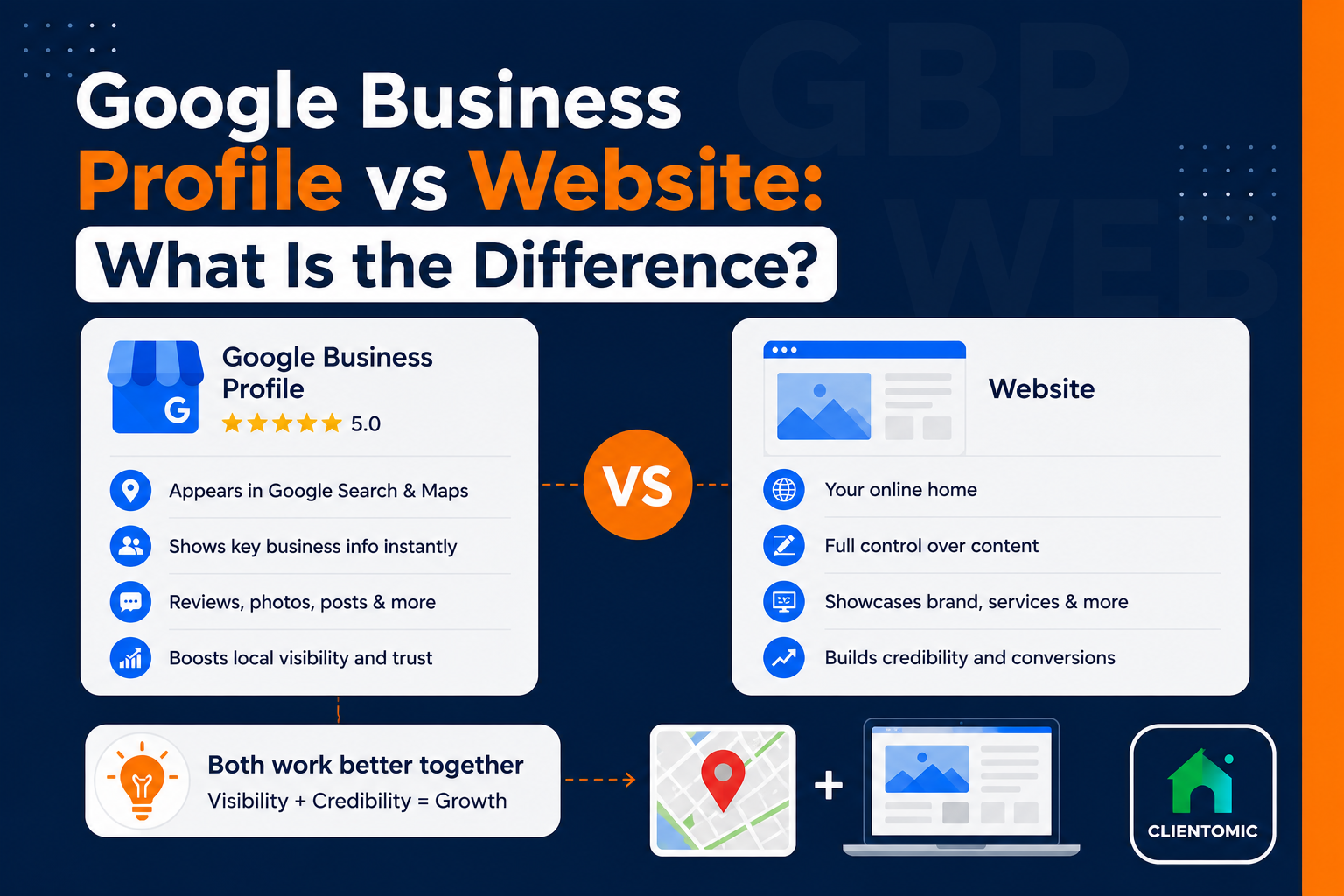
A Google Business Profile is a Google-controlled discovery and action surface; a business website is an owned information and conversion destination. The profile can show essential facts, photos, reviews, directions, calls, and a website link where people already search. The website can explain individual services, areas served, policies, proof, and next steps in much more depth. Local visibility means a business can be found and understood across Search, Maps, AI search, and voice surfaces. An owned web presence means the business controls its domain and published content, even though search engines decide how that content appears in results. A local business normally benefits from both assets because they solve different problems: the profile helps discovery, the site helps decide. Neither asset automatically replaces the other.
A Google Business Profile is a Google discovery surface for local customers; a business website is an owned destination for deeper service information and conversion.
| Point of comparison | Google Business Profile | Business website |
|---|---|---|
| Ownership | Managed by the business inside Google's platform | Published on a domain and site environment the business controls |
| Primary job | Local discovery and quick customer actions | Detailed information, trust, and conversion |
| Where it appears | Google Search and Google Maps | Its own domain and search results that index its pages |
| Visitor actions | Call, get directions, view hours, read reviews, visit the website | Compare services, read policies, submit a form, book, or call |
| Information depth | Structured profile fields and updates | Flexible service pages, FAQs, proof, and resources |
| Business control | The business edits facts within Google's rules | The business controls page structure, copy, and conversion path |
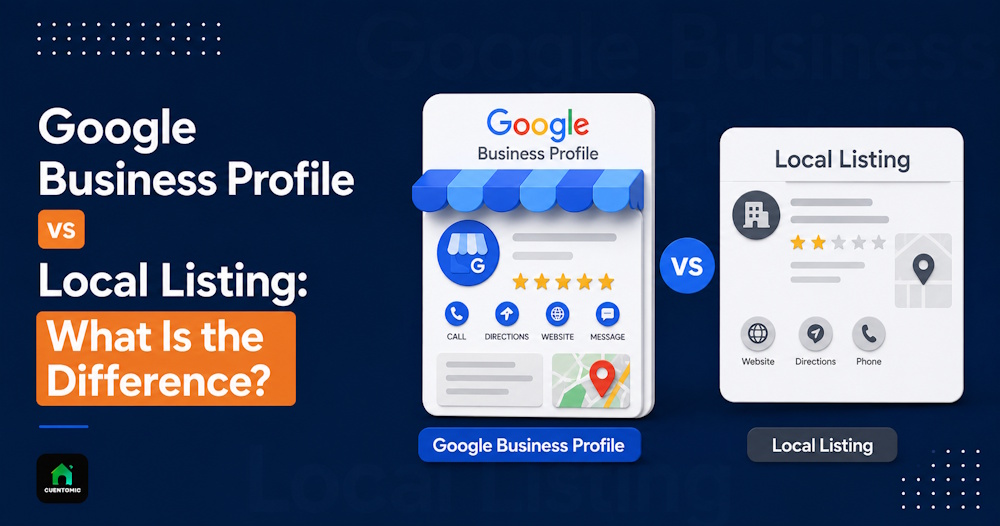
Google My Business is the former name for Google Business Profile. It is not a second product, and it is not the same as the wider local-listing ecosystem explained in Google Business Profile vs local listing.
A Google Business Profile presents a local business's core facts and customer actions on Google Search and Google Maps. Google lets an eligible storefront or service-area business manage how it appears on those surfaces at no charge.[1] The profile can carry the business name, primary category, hours, phone number, address or service area, photos, products or services, reviews, questions and answers, and a link to the business website. A customer can use it to call, request directions, review current hours, or move to the website without first knowing the business by name. A complete profile does not promise a particular position or an appearance for every query. Its practical job is narrower and more useful: help customers choose a next action.
A discovery search is a search for a category, service, or need rather than for a known business name. A homeowner searching for an emergency plumber can compare location, hours, reviews, photos, and contact options from the profile before visiting a site.
Google's product guidance is the right source for profile behavior. A market comparison page can suggest a useful layout, but it should not decide eligibility or platform policy. If the profile is not yet claimed or accurate, use the Google Business Profile setup guide as the next operational reference.
A business website provides owned depth that a Google Business Profile cannot fit into structured fields. A focused site can give each core service a clear explanation, show areas served, answer detailed questions, state policies, present verifiable proof, and offer a usable contact or booking path. Google Search Central describes website ownership verification in Search Console as the first step in establishing a website as an official presence.[2] That ownership matters because the business controls the page structure and can publish context for customers who need more than a phone number and hours. A website does not automatically improve local positions, and a large site is not inherently better than a clear small one. Its value comes from answering buying questions. The website adds depth; it does not remove the need to keep the Google Business Profile accurate.
The shift in search behavior makes the division of labor more important. Search Engine Land reported that 37% of surveyed consumers began searches with AI tools rather than traditional search engines (Search Engine Land, 2026).[3] That finding is not specific to local search, but it shows why a business needs consistent, understandable facts beyond one result screen.
A useful website does not need to become a sprawling publication. A plumber may need clear pages for emergency work, water-heater service, service areas, licensing, and contact options. The profile still answers the faster question: "Who is nearby, open, and reachable?"
Yes. An eligible local business can use a Google Business Profile as its Google discovery layer while its website remains a later priority. Google's profile guidance describes eligibility around serving customers at a storefront or within a service area, and it explains how eligible businesses appear on Search and Maps.[5] The profile can still support discovery, calls, directions, hours, reviews, photos, and other basic actions. The trade-off is depth and control. A profile does not give the business the same room for service explanations, policies, proof, or an owned conversion path. A basic profile-linked page is also not equivalent to a fuller website on the business's own domain. The sensible question is not whether the profile should be ignored until a website exists; it should not. The useful question is whether the profile alone answers enough of a serious prospect's questions. For many service businesses, the profile is the discovery layer and the website is the decision layer.
In our experience and in publicly-reported cases, a local business can earn Google discovery without a full website, but the Google Business Profile and the website still solve different problems.
Clientomic is a done-for-you local visibility service that manages Google Business Profiles for small service businesses so owners get found on Google without handling the day-to-day work themselves. When a business comes to us with only the basic Google Business Profile website option, we typically see a need to separate the profile's quick-discovery role from the website's deeper service and trust role.
A Google Business Profile can help a local business get found without a website, but it cannot become the business's owned home for every service detail, trust signal, and conversion path.
Prioritize the asset with the clearest customer-blocking gap. Start with the Google Business Profile when it is unclaimed, inaccurate, missing essential local information, or unable to support basic calls and directions. Start with the website when prospects can find the business but cannot confirm service fit, coverage, trust, or a clear next step. Work on a minimum version of both in parallel when neither surface is reliable. This is not a universal profile-first or website-first rule. A cleaner with a wrong phone number has a discovery and action problem; a roofer with an accurate profile but no explanation of repair versus replacement has an information problem. Fix the current bottleneck, then connect both assets. The goal is one understandable business across two complementary surfaces, not two disconnected marketing projects.
Which should a local business build first: the Google Business Profile that earns discovery, or the website that explains the business?
| Starting point | Use when | First practical work |
|---|---|---|
| GBP-first | Local discovery or customer actions are broken | Secure access, correct core facts, select accurate categories and attributes, and maintain Q&A and updates |
| Website-first | Prospects lack service detail, trust information, or a usable next step | Create or repair a focused owned destination with service, area, proof, and contact information |
| Parallel minimum | Both assets are incomplete or inconsistent | Publish accurate core facts in both, connect the correct URL, and choose one clear customer action |
You should not need a marketing degree to make this choice. Local visibility should be an outcome the owner can understand, with each asset assigned a clear responsibility.
A Google Business Profile and website should describe the same real business with consistent core facts, aligned services and areas, the correct site URL, and a clear next action. The profile can earn attention on Search and Maps; the website can supply the owned detail that turns attention into an informed call, booking, or form submission. Consistency means the business name, phone, hours, service area, and service descriptions do not contradict one another. It does not mean every sentence must match, and it does not guarantee a particular position. The two assets should also remain useful on their own: a customer should be able to call from the profile, while a visitor should be able to understand and contact the business from the website. This is the practical promised land: discovery works, owned depth answers questions, and both surfaces point to the same business.
Reviewing community discussions and our audit work, we see at Clientomic that mismatched business details across a Google Business Profile and a website create avoidable ambiguity about whether both assets represent the same business.
Check these fields before publishing or approving changes:
The same consistency now matters in AI discovery. SOCi's Local Visibility Index 2026 analyzed more than 350,000 locations across 2,751 multi-location brands. It found that ChatGPT recommended 1.2% of locations, compared with 11% for Gemini and 7.4% for Perplexity (SOCi, 2026).[4] Those figures do not predict results for a single SMB. They show how selective AI recommendation surfaces can be.
SOCi's Local Visibility Index 2026 found that ChatGPT recommended only 1.2% of the local business locations in its 350,000-plus-location sample, so a business should treat its Google Business Profile and website as connected entity signals rather than interchangeable assets.
For the eligibility and access boundary, see who should create a Google Business Profile.
A Managed Local Visibility service should handle recurring Google Business Profile work and state clearly where its responsibility stops. This kind of service typically researches local keywords each month, publishes Google Posts and product or service updates, monitors and answers Q&A, maintains business information and attributes, supports AI and voice-search clarity, and reports monthly SERP performance within a flat monthly scope with no contracts. That scope keeps the profile side active while the owner runs the business. It does not build or maintain websites, run paid ads, build links, manage social channels beyond Google Posts, or generate reviews. A website remains an owned business asset managed separately. The value is not a guaranteed position. It is accountable upkeep across profile signals. If the current discovery gap is unclear, a consultation can confirm whether this managed scope matches the business.
The Google Business Profile management service covers the recurring profile work. It does not turn a website project into part of the package. This division keeps the promise concrete: your Google visibility is handled within a fixed, visible scope.
The right Google Business Profile vs website choice depends on the next unresolved task: connect the correct site, reconcile conflicting facts, choose a site size, set service-area privacy, or separate a current profile from Google's retired website feature. A Google Business Profile handles discovery and quick actions on Search and Maps, while a business website carries owned detail and conversion paths. The answers below cover adjacent decisions instead of repeating the core comparison. Use one preferred website URL, keep business facts consistent, publish only as much site content as customers need, hide a service-area address when Google policy allows, and treat the former Google My Business website feature as different from an owned site. Each answer provides one practical next step without implying ranking results, website delivery from Clientomic, or a universal asset-first rule.
Add the preferred secure URL to the profile, then match the business name, phone, services, and service area across both assets.
Conflicting facts can confuse customers and search systems. Confirm the real hours, phone, location, and services, then correct both assets.
Start with the smallest site that answers buying questions and provides a clear contact path. Add service or area pages only when they provide new information.
Google distinguishes storefront businesses from service-area businesses. A service-area business should configure its address and service-area fields according to Google's current eligibility guidance, publish truthful coverage, and avoid assuming that a storefront-style public address is required for every business model.
No. Google My Business was the former product name; its website feature was a profile-linked page. A current profile and an owned website are separate assets.
If the profile needs ongoing upkeep while your website already works, a call can help confirm the right next step.
Sources:
1. Google Business Profile Help, guidance on managing how a business appears on Maps and Search, accessed 2026. Get started with Google Business Profile
2. Google Search Central, guidance on establishing a website as an official presence and verifying ownership in Search Console, accessed 2026. Add Business Details to Google
3. Search Engine Land, report on consumer use of AI tools to begin searches, 2026. Read the study summary
4. SOCi, summary of AI recommendation rates in its Local Visibility Index 2026. Read the 2026 analysis
5. Google Business Profile Help, guidance on eligible storefront and service-area businesses, accessed 2026. About Google Business Profile and brand profiles
Observations sourced from review of public-community discussions on LocalSearchForum, Reddit r/smallbusiness/r/SEO/r/localseo, and Google Business Profile Help Community in 2025-2026, alongside Clientomic's profile-audit and onboarding work. Patterns reflect qualitative observations across multiple independent threads, not specific customer disclosures.