By Valerie Mitchell · Client Success Manager, Clientomic
Published September 18, 2026
Managed Local Visibility means recurring management of a business's local presence. It is not a Google product or a ranking promise. The practical goal is to give nearby searchers enough accurate information to choose the call button when the cleaning service fits their need. In one Clientomic case, annual profile call actions rose from 114 to 244 (Clientomic, 2026), but that result is evidence from one business, not a promise.[2]
A cleaning business can create more Google Maps call opportunities by making its GBP accurate about real services, actual service areas, hours, and contact details, then maintaining those signals over time. The recurring work can include local keyword research, geo-targeted posts, service and product listings, Q&A optimization, and ongoing profile maintenance. A Google Maps call opportunity means a searcher chooses the profile's call action; it does not mean a booked job, a completed phone conversation, or a complete phone log. Google says local results are mainly based on relevance, distance, and prominence, so no profile edit can purchase a better position (Google Business Profile Help, 2026).[1] The eMaids figures used in this article document one cleaning business across two annual periods. Those figures show what happened in that case, not what another cleaning business will receive.
The shift is simple: a profile that merely exists is not the same as a profile that helps a customer decide. A vague service list makes the owner hard to evaluate. Clear cleaning services, truthful coverage, current hours, and a working phone number remove avoidable doubt.
Businesses that maintain those facts give searchers a clearer path from discovery to contact. Businesses that leave old hours, broad descriptions, or missing services in place make the choice harder, even when the cleaning work itself is excellent. Getting more calls from Google Maps is a profile-operations problem, not a ranking promise.
Monthly Google Business Profile management keeps profile information and useful content aligned with the cleaning business as services, schedules, and coverage change. Monthly work does not buy a ranking or a call result. The documented workflow for the eMaids case covered five areas: local keyword research, geo-targeted posts, service and product listings, Q&A optimization, and ongoing profile maintenance. Local keyword research maps real cleaning services to the locations the business truly covers. Posts and Q&A make current customer questions easier to answer. Service and product listings state what the company offers. Profile maintenance checks factual fields such as categories, attributes, descriptions, hours, and contact information. The value of monthly management is continuity and accountability: someone keeps the profile aligned with the real operation instead of leaving a one-time setup to drift. Google documents the profile features, but Google does not attach a fixed performance outcome to their use.
For a cleaning-business owner, the five work areas translate into practical upkeep:
This scope does not include paid ads, website development, backlink outreach, broad social-channel management, or asking customers for reviews. Review generation in the eMaids case was driven by the business owner; Clientomic does not manage reviews.
The eMaids case measured an annual, like-for-like comparison from one named Google Business Profile, not an industry benchmark or a forecast. eMaids of Henry, Clayton & Fayette Counties is a house cleaning service in McDonough, Georgia. The baseline covered April 2024–March 2025, when the profile recorded 114 annual phone calls, or roughly 9–10 per month. The first management year covered April 2025–March 2026, when the profile recorded 244 annual phone calls, or approximately 20 per month. Phone calls therefore changed from 114 to 244, a published increase of 114% (Clientomic, 2026).[2] The same source reports changes in impressions, website visits, and new reviews. All figures came from Google Business Profile Performance data for the stated periods. The review increase was owner-driven, and Clientomic does not manage reviews. One profile's annual comparison cannot predict another cleaning business's result.
The published eMaids case study reports the following source-bound figures (Clientomic, 2026):[2]
| Google Business Profile Performance metric | Baseline: April 2024–March 2025 | Management year: April 2025–March 2026 | Published change |
|---|---|---|---|
| Impressions | 2,169 | 8,279 | +282% |
| Phone calls | 114 | 244 | +114% |
| Website visits | 256 | 667 | +160% |
| New reviews | 12 | 101 | +742% |
In the eMaids case, Google Business Profile impressions rose from 2,169 to 8,279, while website visits rose from 256 to 667 (Clientomic, 2026).[2] New reviews rose from 12 to 101 during the same comparison, but the business owner drove review generation. The case supports a conclusion about sustained profile work for this named business; it does not establish an average for cleaning companies.
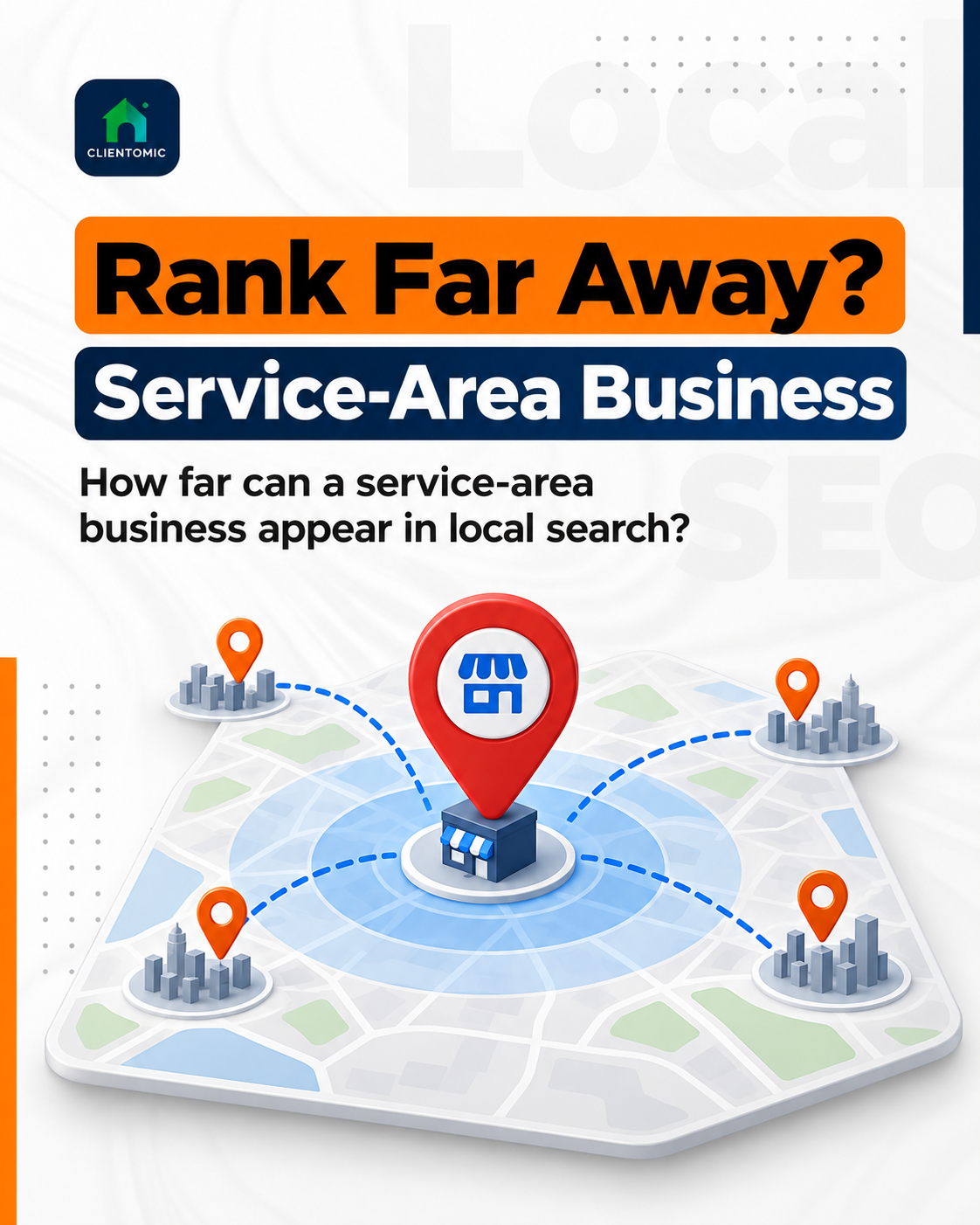
Geographic coverage matters because a cleaning profile should describe where the business really operates and which services it provides in those places. The eMaids source reports growth from roughly a dozen keywords to over 1,500 local search query variations across 27+ cities and counties (Clientomic, 2026).[2] Those numbers describe the documented content and query footprint of one profile; they are not recommended targets for every cleaning business. Google's service-area settings are a different concept. Google allows a service-area business to specify up to 20 service areas and says the overall area generally should not extend beyond about two hours of driving time from the business base (Google Business Profile Help, 2026).[5] Neither the setting nor the eMaids query footprint acts as a call-routing fence. Accurate geographic language helps Google and searchers understand fit, while distance and competition still affect what appears for each search.
A service-area setting tells Google where a business serves customers. Content and query coverage describe how services and places appear across the profile's information. The two should agree, but they are not interchangeable.
A cleaner serving three neighboring counties should describe those real counties and the services available there. Adding distant city names merely to widen the footprint can make the profile less trustworthy and does not ensure calls. The useful standard is factual alignment: the service list, service-area settings, posts, Q&A, and phone path should all describe the same operating business.
A cleaning business should measure Google Maps calls by defining the metric before judging performance. Google Business Profile Help defines Calls as the number of times a customer clicked the call button on the profile (Google Business Profile Help, 2026).[6] The metric does not count every phone conversation, lead, customer, booked cleaning, or dollar of revenue. Business Profile Performance also separates searches, views, direction requests, website clicks, and call actions. Compare like-for-like date ranges so busy seasons and quiet seasons do not distort the picture. For a seasonal cleaning business, one full year against the preceding full year provides more context than comparing an unusually busy month with a slow one. Keep a separate business phone log for answered calls, missed calls, caller location, requested service, and booked work. The combination shows both what the profile generated and what the operation converted.
Use a small measurement stack instead of one headline number:
If profile activity rises but the phone remains quiet, separate visibility from contact-path problems. Our guide to a Google Business Profile that gets views but no calls explains how to diagnose that gap without treating views as booked work.
The eMaids case does not prove a guaranteed ranking, call count, lead total, booked-job total, conversion rate, payback period, or universal timeline. The published figures describe one profile in one market across two specific 12-month periods. Outcomes can vary with competition, profile history, seasonality, service footprint, searcher distance, business hours, call handling, and the services a cleaning company offers. The source page says initial changes in search visibility typically appear within 4 to 6 weeks (Clientomic, 2026), but that statement is not a promise that calls or rankings will change within that window.[2] The review count in the case rose from 12 new reviews to 101, yet the owner drove review generation. Clientomic does not manage reviews. Past performance cannot establish what another business will receive.
The distinction protects the owner's decision. Evidence should show what work occurred, what the measurement captured, and what changed. A forecast would require facts about the new market, existing profile, competition, seasonality, and phone handling that this case does not provide.
The case also cannot isolate one winning action. Local keyword research, posts, service and product listings, Q&A, and maintenance ran as a combined monthly workflow, and across the profiles we manage at Clientomic, results always reflect that combined work rather than any single change. Claiming that one post, one city, or one category caused the annual change would go beyond the source.
One-time GBP optimization can establish or correct profile information, while monthly management repeatedly reviews and updates the five documented work areas. Initial work can fix categories, descriptions, hours, contact details, services, products, Q&A, and service-area information. Monthly management then checks whether those facts still match the business, refreshes useful posts, maintains service and product listings, answers relevant Q&A, and updates the local keyword map as services or coverage change. The operational difference is continuity, not a promise that a fixed publishing cadence will cause a measurable lift every month. A one-time correction may be enough for a stable factual error. A recurring workflow fits a business whose services, seasonal demand, hours, customer questions, or geographic coverage change. The owner is buying accountable upkeep of the profile, not control over Google's local results.
| One-time profile work | Monthly profile management |
|---|---|
| Corrects current factual errors | Rechecks facts as the business changes |
| Establishes services, products, Q&A, and coverage | Maintains those fields and useful content over time |
| Creates a clean starting point | Compares performance across consistent periods |
Clientomic is a done-for-you local visibility service that manages Google Business Profiles for cleaning businesses so owners get found on Search and Maps without handling the upkeep themselves, offering ongoing Google Business Profile management as part of Managed Local Visibility. The service handles profile work within that defined scope. It does not include paid promotion, broad website work, backlink outreach, broad social-channel management, or review requests.
Check the phone number, hours, primary category, listed services, and service areas first. Then compare the same date range with the prior period in Business Profile Performance. Google counts a call when someone selects the call button, so a separate phone log is needed to identify missed calls and booking outcomes (Google Business Profile Help, 2026).[6]
Confirm that Google approved the edits and that the visible profile still shows accurate contact and service information. Google says service-area edits can take up to 48 hours to appear (Google Business Profile Help, 2026).[5] Compare a longer, like-for-like period before connecting one edit to a call decline, because seasonality, distance, competition, and phone handling may also affect the result.
Yes, if the profile reflects the real operating model. Google lets eligible service-area businesses list up to 20 service areas and advises keeping the overall area within roughly two hours of driving time from the base (Google Business Profile Help, 2026).[5] A single location does not require a separate profile for every city served.
Google Business Profile Calls count selections of the profile's call button. Website leads begin after a person visits the website and contacts the business through a form, tracked number, chat, or another recorded path. The eMaids case reports phone calls and website visits as separate annual metrics (Clientomic, 2026).[2] Neither metric alone proves a booked cleaning.
Owner-requested reviews remain the owner's work and should be reported separately from managed profile tasks. In BrightLocal's survey of 1,002 US adults, 97% said reviews guide purchase decisions (BrightLocal, 2026).[7] The consumer finding provides context; it does not predict calls for a cleaning business, and Clientomic does not request reviews.
Self-management can work when one person reliably owns services, posts, Q&A, hours, coverage, and measurement. Monthly help can fit an owner who cannot keep that routine current. Compare scope, reporting, and responsibility; the decision is about dependable upkeep, not access to a special ranking control.
If recurring profile upkeep fits your cleaning business and service area, a short call can clarify the scope and measurement approach.
Sources:
1. Google Business Profile Help, guidance on relevance, distance, prominence, and local ranking, read 2026. Review Google's local ranking guidance
2. Clientomic, eMaids of Henry, Clayton & Fayette Counties case study and two-period Google Business Profile Performance comparison, 2026. Read the published eMaids case study
3. Google Business Profile Help, guidance for managing services on a Business Profile, read 2026. Review Business Profile services guidance
4. Google Business Profile Help, guidance for creating and managing Business Profile posts, read 2026. Review Business Profile posts guidance
5. Google Business Profile Help, guidance for managing service areas, read 2026. Review service-area guidance
6. Google Business Profile Help, definitions for Business Profile Performance metrics, read 2026. Review Business Profile Performance guidance
7. BrightLocal, Local Consumer Review Survey 2026, 2026. Read the survey