
By Ivan Kalin · Local SEO Expert & Founder at Clientomic
Published May 15, 2026
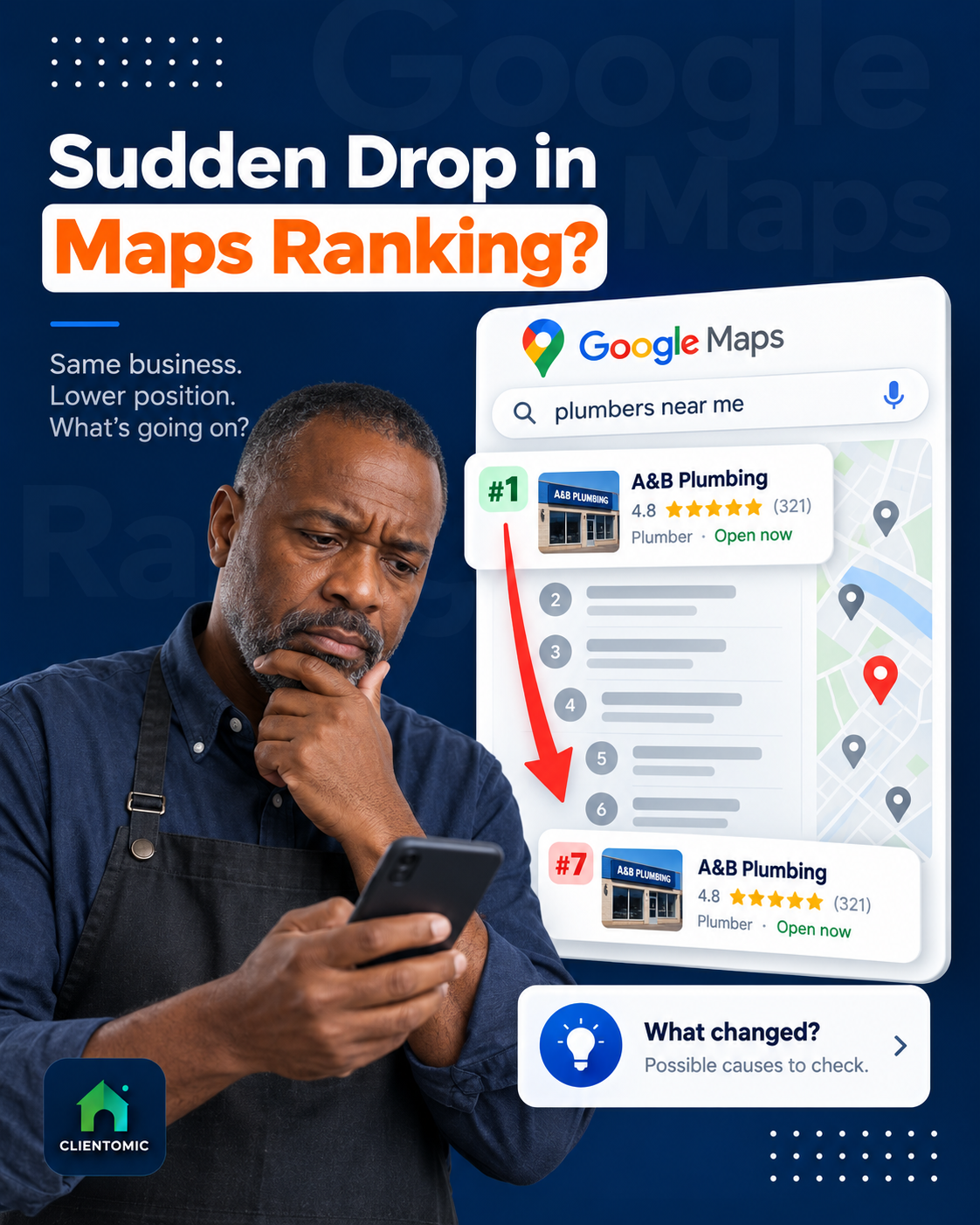
A business usually stops showing on Google Maps because the profile is unverified, incomplete, suspended, misconfigured, or still reprocessing after recent changes. Google says rankings for new businesses can take up to one month to appear, and profile edits can take up to three days to show in search results, so "live" and "visible" are not the same state.[1]
A Google Business Profile is the listing system that lets a business control how it appears on Google Search and Maps. Managed Local Visibility means keeping that profile accurate, active, and trusted over time instead of treating it like a one-time setup task. Clientomic is a Managed Local Visibility service for service businesses that need their Google Business Profile maintained without turning profile upkeep into another job for the owner.
A Google Business Profile that exists is not the same as a Google Business Profile that can be found: existence is account state, visibility is a moving target shaped by verification, accuracy, and local ranking signals.
If your phone has gone quiet, this is usually the reason. The profile may still exist inside your account, but nearby customers may not be seeing it when they search. That gap matters more now because Yext reported in 2026 that 47% of U.S. adults used an AI tool to find a local business in the past month, which means local visibility is spreading beyond the classic map pack into AI-assisted discovery too.[5]
| Profile state | What Google/customer sees | Business consequence |
|---|---|---|
| Verified, complete, current | Accurate hours, contact info, category, service details, recent proof | Higher eligibility to appear and stronger trust |
| Claimed but stale | Thin photos, old hours, mismatched details, weak upkeep | Lower confidence and more dropped actions |
| Missing, restricted, or unverified | Limited control, inconsistent data, no clear trust signal | Lost visibility and fewer calls or directions |
Use this quick diagnostic order before you assume the problem is "SEO":
Most businesses stop showing on Google Maps for one of five reasons: the profile is not verified, the information is incomplete or inaccurate, the address or service-area setup does not match the real business model, Google has restricted or suspended the listing, or the profile is still reprocessing after a recent change. Google says only verified businesses can show business information on Maps and Search, and it also says edits can take up to three days to appear while rankings for new businesses can take up to a month to settle.[1][4] That means a business can be technically claimed while still being practically invisible. In plain English, the problem is usually not "Google forgot you exist." It is that your profile is either not eligible, not trusted enough, or not yet re-surfaced for the kind of search you care about.
The first mistake owners make is treating every missing-profile case as the same problem. It is not. Some profiles are missing because Google has not finished processing them. Some are missing because the information is too thin or too stale to compete. Others are missing because the listing has crossed a policy line and stopped appearing at all.
Google frames local ranking around relevance, distance, and prominence.[2] That is useful because it separates two issues cleanly. Eligibility decides whether your profile can appear. Ranking signals decide how often it actually does appear when the profile is eligible.
Google says rankings for new businesses can take up to a month to appear, and profile edits can take up to three days to surface in search results, which means a business can be technically live before it is practically visible.[1]
This is usually a state-and-scope question, not a generic SEO problem. If the profile is missing by exact name, start with verification, restriction, suspension, or a recent account change. If the profile appears by name but not for category searches, the problem is usually ranking competitiveness, not total disappearance. Google says local results depend on relevance, distance, and prominence, so the same profile can be visible in one context and weak in another.[2] For service-area businesses, a hidden address does not automatically mean the listing is broken; Google allows eligible businesses to represent their real service model without a storefront pin.[4] That is why the fastest fix order is state check first, ranking cleanup second, and service-model check third. Local Search Forum discussions also show that branded visibility can stay intact while category visibility remains weak when trust signals are underdeveloped.[9]
What does "not showing on Google Maps" actually mean: missing by exact business name, missing only for category searches, or missing because Google has stopped showing the profile at all?
If the business is missing by exact name, start with account state and policy state. That usually means verification, a hidden restriction, a profile merge problem, or a suspension issue. If the business appears by name but not by service and city terms, the profile may be working normally but not competing well enough for discovery searches yet.
That second case is frustrating because it feels like disappearance even when the listing still exists. But it matters because the fix is different. Ranking weakness needs better profile accuracy, stronger local proof, and more consistent upkeep. A missing branded profile usually needs a state check first, not more content.
The most common profile-level blockers are simple, but they compound fast: missing verification, weak category selection, incomplete core fields, stale contact details, and service-area or address settings that do not reflect how the business actually operates. Google says complete and accurate business information makes it easier to match a profile to relevant searches.[2] Google also requires that the business be represented as it exists in the real world, which means the category, address visibility, and service model all need to line up with reality.[4] A listing does not need to look "perfect" to show, but it does need to look coherent. When the profile sends mixed signals, Google has less reason to trust it and less reason to surface it for discovery searches.
Verification is the first gate. If the profile is not verified, the visibility ceiling is low from the start.[1] After that, category fit usually matters more than owners expect. A business with the wrong primary category can exist, be claimed, and still fail to appear for the searches that actually matter.
Stale business details cause a quieter version of the same problem. Old hours, a disconnected phone line, a mismatched website URL, or a half-finished edit sequence can weaken both trust and matching. For service-area businesses, the problem is often conceptual: owners expect a storefront-style presence even when the profile is configured around service areas rather than a public address.
This is also where one-time setup fails. The profile may have been correct six months ago. That does not mean it is still correct after staff changes, service changes, seasonal hours, or a rebrand.
When Google suspends, disables, or otherwise stops showing a profile, the problem moves from ranking to recovery. At that point, the goal is not to "optimize harder." It is to confirm the listing state, understand whether the issue is profile-level or account-level, and follow Google's appeal path without creating a duplicate listing that makes the situation worse. Google provides a suspension and appeal workflow for profiles that no longer appear because of policy or moderation issues.[3] In practice, this is the highest-stakes version of the problem because a suspended or disabled profile can disappear even if the business itself is legitimate. If the listing has truly dropped out of view, treat it as a state problem first and a visibility problem second.
Across the multi-profile GBP cases we audit, one acute failure mode is a manager-account flag cascading to every client profile that account touched, which means recovery often requires separating the flagged account from each listing and handling reinstatement profile by profile rather than as one clean account-wide fix.
When a provider comes to us after losing access to multiple client profiles at once, we typically see the underlying trigger sitting at the manager-account tier instead of any one business listing, so the business experiences a visibility loss that looks random even though the recovery path is procedural.
That nuance matters because many businesses assume disappearance always means they filled out something incorrectly. Sometimes it does. Sometimes the problem is a moderation state change higher up the chain. Local Search Forum reports on profiles becoming invisible without notice show why blanket assumptions are risky: the visible symptom can look random even when the recovery path is procedural.[8]
If you are here, do not create a duplicate profile as a shortcut. Start with Google's current suspension workflow, document the state, and keep the recovery path clean.[3]
Service-area businesses often misread Google Maps visibility because they expect a storefront-style pin experience from a profile model that is built differently. Google allows eligible businesses that serve customers face-to-face in a service area to appear on Search and Maps without operating as a walk-in storefront, but the profile still has to match the business model truthfully.[4] That means a hidden address does not automatically mean the profile is broken. It means the business should be judged through service-area eligibility, category fit, and search behavior, not through the expectation that every customer will see a public storefront marker. Many "not showing" complaints from service businesses are really expectation mismatches between how the owner thinks Maps should behave and how Google actually handles service-area representation.
Google's guidelines focus on representing the business as it really operates.[4] If the business serves customers at their location, the service-area setup can be correct even when the owner does not love how it looks on the map. Local Search Forum discussions around service-area visibility show the same confusion repeatedly: the owner assumes missing pin equals missing profile, when the real issue is often how they are testing visibility or how the listing is configured for their model.[10]
For service-area businesses, the better test is not "Do I see a storefront pin exactly where I expect it?" It is "Can the right nearby customer still find me for the relevant service searches?"
The fix is rarely permanent if nobody owns the upkeep. Hours change, categories drift, photos age, service details expand, and policy-triggering edits can create fresh visibility problems weeks after the original issue seemed solved. Google says complete and accurate information improves local ranking, which means profile maintenance is not cosmetic work. That maintenance burden matters more now because Yext reported in 2026 that 47% of U.S. adults used AI tools to find a local business in the past month, while SOCi's 2026 Local Visibility Index found that only 1.2% of local businesses were recommended by AI search.[5][6] Visibility is getting more selective, not less. A one-time cleanup can restore a listing. Ongoing management is what keeps it from slipping again.
Owners usually understand the profile matters. The problem is remembering to maintain it after the urgent fire is out.
Managed Local Visibility is the operating answer to that drift. It means someone is checking whether the profile is still accurate, still trusted, and still aligned with how the business actually serves customers. That includes the routine work owners delay when the week gets busy: hours, categories, photos, service details, Q&A, and visibility checks after important edits.
If you want a practical example of what recurring upkeep includes, see what recurring Google Business Profile work includes. If you want to understand the broader performance layer after the profile is visible again, what actually improves Google Business Profile performance is the next useful read.
Google says rankings for new businesses can take up to 1 month to appear, and profile edits can take up to 3 days to surface in search results.[1] If the profile is verified but still missing after that window, move from waiting to diagnosis.
Treat that as a ranking problem, not a total-disappearance problem. Review the 3 local ranking factors Google names: relevance, distance, and prominence, then tighten your primary category, completeness, and current business details.[2]
Yes. A service-area business can be valid without behaving like a storefront pin. The key question is whether the profile matches the real service model and can still appear for nearby service searches, not whether it looks like a walk-in location.[4]
Yes. Google says profile edits can take up to 3 days to appear in search results, and newer visibility states can take longer to settle.[1] A recent change can create a temporary visibility dip before the profile stabilizes again.
Usually it makes the problem worse. If the issue is suspension, restriction, or a state mismatch, duplicating the listing creates a second problem instead of fixing the first. Use the existing profile and Google's recovery workflow first.[3]
No. A hidden address does not automatically block visibility. Google allows eligible businesses that serve customers at their location to appear on Search and Maps without presenting themselves as a storefront.[4]
Start with time and state. If the profile is brand new, Google says rankings can take up to 1 month to appear.[1] If the profile was visible and then disappeared or shows restriction signals, treat it as a possible suspension or moderation issue first.[3]
Monitor the fields that drift first: hours, primary category, phone, website, service details, and any major edits that could trigger reverification. If the business changes often, a monthly review is usually the minimum safe cadence.
If the issue is simple and recent, you can often fix it yourself. If the profile keeps drifting, keeps losing visibility after edits, or affects a busy service business that cannot monitor it weekly, managed upkeep is usually the better operating choice.
Google Maps visibility problems rarely come from one dramatic mistake. They usually come from a profile that is unverified, stale, misaligned, restricted, or simply left unmanaged long enough for small issues to stack up. If you want help fixing the current issue and keeping it from returning:
Observations sourced from review of public-community discussions on LocalSearchForum, Reddit r/smallbusiness/r/SEO/r/localseo, and Google Business Profile Help Community in 2025–2026, alongside Clientomic's profile-audit and onboarding work. Patterns reflect qualitative observations across multiple independent threads, not specific customer disclosures.
Sources:
1. Google Business Profile Help — Visibility rules for finding a profile on Maps and Search, 2026. Read the help page
2. Google Business Profile Help — Local ranking factors and completeness guidance, 2026. Read the help page
3. Google Business Profile Help — Suspension and appeal workflow, 2026. Read the help page
4. Google Business Profile Help — Representation guidelines and eligibility constraints, 2026. Read the help page
5. Yext — Consumer Search Behaviors report findings for AI and local discovery, 2026. Read the report
6. SOCi — The Factors Driving AI Visibility report, 2026. Read the report
8. Local Search Forum — Profiles becoming invisible without notice and deletion-suspension diagnosis, 2024–2025. Read the discussion
9. Local Search Forum — Category-query visibility mismatch discussion, 2022. Read the discussion
10. Local Search Forum — Service-area business pin visibility discussion, 2019. Read the discussion